Friday, August 5, 2016

Civil Blood

Troilus and Cressida at the Delacorte Theatre

(L-R: Andrew Burnap, John Glover, and Ismenia Mendes in Troilus and Cressida.)

            Explaining away Shakespearean problem plays is a tough business.  It’s tempting to suggest everything the Bard ever wrote was intentional, that he foresaw trends in theater that had not yet struck the rest of Elizabethan England, that he is without flaw.  The truth is that he was sometimes, if not lazy, a little messy – and Troilus and Cressida, from 1602, reflects that messiness.  It’s unsure whether it wants to be a history, a tragedy, or a romance, and that, naturally, excites veteran theater directors like Daniel Sullivan, who have tired of trying to reinvent the wheel, or, more immediately, figure out what the hell Hamlet is talking about.  Sullivan’s directing a production of Troilus and Cressida at Shakespeare in the Park right now, and it’s shocking how much he succeeds in justifying the thematic schizophrenia of the text (while also justifying a surprisingly fleet three-hour running time).  But one’s well-served to read the play before visiting, before closing on August 14th, to see how far the production, flawlessly acted, directed, and designed, outstrips the promise of the text itself.
            The atmosphere is thrillingly alive even in its malaise.  In a far-off war zone (presumably Middle Eastern) standing in for the battlefields of Troy, great warriors have been fighting for seven years over an argument they no longer remember, in a war so uncertain they can eat dinners and stage cage matches together in all friendship and go out and slaughter each other the next day.  Sullivan’s battle scenes, supremely staged (if a little loud – Shakespeare would have found it difficult to imagine submachine guns) are as beautifully chaotic as anything out of Apocalypse Now (for which thanks are mostly due to his designers, David Zinn, Robert Wierzel, and Mark Menard).  It’s a world of fear and continual bloodshed, surrounding the stillness of men; fitting, for Troilus and Cressida is really a play about love – that most human of impulses – during war – that least human.  The little, text-bending changes (one involving Corey Stoll’s majestic, battle-scarred Ulysses nearly made me squeal) are pitch-perfect.  It is a production, in light of retrospect, as good as anything I am ever likely to see in the park in my lifetime.  It makes no apologies, only room for its actors to shine.
            It’s rare, incidentally, to describe a Shakespeare in the Park production as “flawlessly acted” and mean it.  A Delacorte production, with its colliding and admirable tendencies both to be devoted to the text and to reinvent it for a new era, doesn’t leave a lot of room for actorly innovation, and even the strongest performers (Judy Gold in this summer’s Taming of the Shrew; Sam Waterston in last summer’s The Tempest) can’t make the language seem real.  It’s a tough hurdle – one this male ensemble, the strongest this side of 2013’s Twelfth Night on Broadway, surpasses with ease.  (There are two women, Tala Ashe as Helen and Andromache and Ismenia Mendes – on whom more later – and both are equally extraordinary.)  I’ve never seen a production where it was so hard to name standouts, perhaps partially because the intertwining storylines – two little sections from the Iliad blown up into a not-quite-larger story – give everyone their time upon the stage.  Goddamnit, everyone is great – Stoll as a military contractor who has lost the will to do anything but win, John Glover as a Pandarus exquisitely rendered from beginning to end, Max Casella as a hysterical Thersites, here a sniping janitor in the Greek camp, and Louis Cancelmi, an extraordinary Caliban in last year’s Tempest, who here makes a frighteningly focused Achilles, whose slurred words and lackadaisical movements somehow make him more frightening.
            Of course, one must be fair even in as talented a group as this and acknowledge that one person out-acts the entire cast without breaking a sweat.  It’s just a bit of a shock he only graduated from the Yale School of Drama this year.  Andrew Burnap as Troilus is a revelation – real, sympathetic, funny, human, in every movement, every word.  Troilus, a thinly sketched character at best, here has his story told as thoroughly as it can be.  And in this production of the play, which for all its sweep reminds us of the love that can be destroyed by conflict, he would be nothing without his Cressida, and Mendes stands alone on stage not only because she is mostly the only woman on it (though this fact makes for some genuinely frightening action in the second act, brilliantly staged by Sullivan and hammering home the amorality and the immediate effects of sustained war).  She is fascinatingly modern even while delivering text written four centuries ago about a conflict which took place eight centuries ago.  It is hard to overstate how well this serves her – whether in Troilus and Cressida’s first scene together, which contains the modern seeds of romantic comedy in their sweetest form, or in her terrors as a prisoner of the Greeks in the second act, a bundle of jangling nerves and a woman destroyed.

            Separately, Burnap and Mendes frame this production; together, they make it.  This staging blends large and small, love and war, pain and ecstasy.  So do they.  They are its microcosm and its epicenter, a small, blooming, bleeding heart that reminds us what we could do if we decided once and for all to wage war no more.

Thursday, July 28, 2016

Money For Nothing

God Bless You, Mr. Rosewater at City Center Encores! Off-Center
 
Santino Fontana (foreground center) and the company of God Bless You, Mr. Rosewater.

                It’s easy to forget that God Bless You, Mr. Rosewater, now at City Center as part of the Encores! Off-Center series through July 30th, is what Off-Center is supposed to be about.  The past three seasons of its existence have seen shows that are under-produced on Broadway (Little Shop of Horrors in 2015), under-seen generally (Tick… Tick… Boom in 2014), or just in a new stage of development (Violet in 2013).  But we have seen all too few musicals that, like this one, are little-known for just one reason – they are completely and utterly insane.
                The first collaboration of Alan Menken and the hugely underrated lyricist/librettist Howard Ashman, and an adaptation of Kurt Vonnegut’s 1965 novel of the same name, ran 49 performances Off-Broadway in 1979 before shuttering abruptly (wrote Vonnegut to Ashman later that year: “We concluded that theater people are not supposed to be paid, probably, and that maybe that was OK”).  It is, by any measure, a hot mess – alternately excessively mordant and ahead of its time, and tonally all over the map.  But it is a window not only on the early development of Menken and Ashman (who would go on to write Little Shop and the entire Disney Renaissance catalogue) as songwriters but also into the style – coldly satirical and dismissive of good old Americana in a way only Vonnegut could be – that would inform them on a much deeper level.  Deep in the mulch of Rosewater, Audrey II blooms.
                Which is not to say that Rosewater is bad – it isn’t remotely so.  For one thing, the book – which borrows liberally from Vonnegut’s text, as anyone would – is hysterical and expert.  We follow the travails of the scion of the Rosewater aristocratic family, Eliot (Santino Fontana), as he abandons his family’s foundation and his long-suffering wife (Brynn O’Malley) on a search for spiritual fulfillment – what he wants more than anything else, though he can’t quite figure out how to do it, is to help people.  In a Vonnegut text, that can only mean that he is completely out of his mind.
                He is, and therein lies the rub – as Eliot settles in his hometown of Rosewater County, IN, dispensing liberally both his fortune and advice to the locals (his handmade signs, which he hangs around town, read “Don’t Kill Yourself: Call the Rosewater Foundation"), it is impossible to fully sympathize with him; in fact, we are not meant to do so.  Our antagonist, played magnificently by Skylar Astin as a monstrous cartoon straight out of Dickens, is a lawyer looking for a piece of the Rosewater Foundation’s millions by having Eliot declared legally insane (his villain song, “Mushari’s Waltz (Magical Moment),” is a proto-Disney mini-masterpiece that clearly informed “Poor Unfortunate Souls” and the like).  We feel we shouldn’t agree with him, but we do.  Eliot thinks he’s Hamlet.  He’s obsessed with oxygen and volunteer fire brigades.  He worships a fourth-rate science fiction hack, Kilgore Trout (James Earle Jones in a delightful last-scene cameo).  Eliot Rosewater is completely off the deep end.  And so is this show.  That’s what makes it so much fun.
                In Michael Mayer’s direction, the stage bursts with color and movement from a hundred different directions, choreographed (by Lorin Latarro) almost to appear un-choreographed.  The music jumps from genre to genre – Eliot sings, as in the excellent “Look Who’s Here” and “I, Eliot Rosewater,” in pseudo-gospel to echo his proud philanthropic journey; Mushari’s dastardly waltzes and tangoes lampoon everything from the legal system to that old Menken and Ashman standby, suburbia; and perhaps the best song in the show, “Plain Clean Average Americans,” sung by the full company in American flag vests and very familiar-looking floppy blonde wigs, reminds us that perhaps it is better to be completely removed from reality than to be craven enough to abhor one another.  The script is alternately viciously parodic and deeply poignant in a way that almost brings on whiplash.  (The cast, incidentally, read from scripts disguised as Kilgore Trout novels, a nice touch made awkward only by Clark Johnson as Eliot’s father, a Senator, who on opening night stumbled so many times he must have left five full minutes of dead air.)  This is a totally ridiculous production of a totally ridiculous show.  But I think we might need more ridiculous shows.
                What brings it all together, unsurprisingly, is the phenomenally talented Santino Fontana as Rosewater.  His masterful John Adams in 1776 earlier this year combined with this role, a man whose descent into insanity paradoxically makes him more sympathetic, make him by default a City Center staple, the de facto host and star of Encores!.  He is absolutely transfixing.   Watch as someone calls the fire brigade line at the Rosewater Foundation, desperate for personal advice, and he explodes: “God damn you for calling this number.  You should go to jail and rot.  Stupid sons of bitches who make personal calls on a fire department line should go to hell and fry forever.”  He slams down the phone.  The direct line rings, and he picks it up and answers sweetly, “Rosewater Foundation, Rosewater speaking, how can I help you?”  Fontana is a master at work – he can make any role, even this relatively underwritten one, the heart and soul of a production. 
Rare is the musical that is stopped dead not by an all-out number but by a tearful, terrifying monologue – one that, in its clarity and focus, twists the narrative into something beyond what we’ve expected.  Santino Fontana delivers that monologue.  He is extraordinary.  The show really isn’t, but if he’s not worth watching, then what is?

Friday, July 15, 2016

The Room Where it Happens

Oslo at the Mitzi E. Newhouse           
 
(L-R: Jennifer Ehle and Jefferson Mays as unconventional diplomats in Oslo.)

            For those of us who have gazed despairingly from the sidelines at seemingly endless cock-ups by politicians of levels high and low and thought to ourselves, “Well, I could do better than that!” there is some dramatic vilification, in the midst of a season rife with discord both political and Middle Eastern, in the form of J.T. Rogers’ breakneck new play Oslo, at the Mitzi E. Newhouse.  Those peace accords emblazoned with the name of that Norwegian city, evidently, were not limited to a brief and hugely unconvincing handshake between Yasser Arafat and Yitzhak Rabin on the White House Lawn in September 1993, nor were they executed, even remotely, by the jolly Arkansan who oversaw the photo opportunity with the proprietary glee of a P.T. Barnum. 
Actually, a complex Scandinavian endeavor, rife with borderline-illegal cooperation between the public and private sectors, was responsible.  Mr. Rogers, to correct the record, has condensed the nine months of fascinating and strikingly original diplomacy that made at least a semblance of peace in the Middle East for seven glorious years into a three-hour, three-act wonder that never seems overburdened or too cute for its own good.  It’s part comedy of errors, part history lesson, and so far is that atmospheric combination from disjointed that the only places where it falters come when it ventures too far into one or the other.
To begin with – Oslo, directed by the LCT’s patron saint, Bartlett Sher, is near-impossible to summarize.  If I may quote liberally from the foot-long insert I received with my Playbill – Terje Rod-Larsen (the phenomenal Jefferson Mays) is a think-tank president married to Mona Juul (Jennifer Ehle, also excellent), a Norwegian Foreign Ministry official.  Out of what seems, partly, to be a genuine feeling for the people of the region, and partly out of the desire to impose order onto a chaotic world and then take credit for having invented order that is so distinctly Scandinavian, the two initiate a series of clandestine meetings between PLO Finance Minister Ahmed Qurie (Anthony Azizi, deeply felt) and a delegation of Israeli professors from the University of Haifa, that eventually lead to extended talks between the PLO and Israeli Foreign Ministry Director-General Uri Savir (Michael Aronov).  Throughout, those at the top in the Norwegian, Israeli, and Palestinian governments are relegated to strictly need-to-know status.  Rod-Larsen, after all, is trying to impose a policy of personality, of gradualism, onto Middle Eastern diplomacy.  Naturally, the Americans can’t be involved.
The little winks and fourth-wall breaks that come throughout nod to how impossible to follow the whole thing is, but really Rogers’ portrayal is so masterfully done I was never once confused.  The strongest scenes in the piece come in the negotiation sessions between Qurie and Savir, one a strong-willed populist, the other a bespoke-suit-wearing playboy – they have incredible literary personality besides keeping you on the edge of your seat.  You get the sense of a real window into a history-making process.
But the real stars of the proceedings are Rod-Larsen and Juul, played perfectly by Mays and Ehle as teammates in the grandest sense.  In their own, dilettante way, they are trying to do something they know is right – even if their own glory may be an added attraction.  Ehle, sporting a flawless accent and a presence somehow simultaneously steely and maternal, fulfills the promise of the character – beloved by all on both sides because of her ability and willingness to bring people together.  Mays is perfect as the intellectual who thinks – knows – he can do better than the bureaucrats, with all of the well-meaning arrogance that entails.  The actors are just as much of a team – and just as successful, in a different way – as their real-world counterparts.

I couldn’t help but be reminded of the surprisingly short-lived Shuffle Along at the conclusion of this thoroughly exemplary play, as we are treated to a laundry list of diplomatic failures and disappointments that followed the accord’s signing in the early ‘90s.  At the end of that musical, the stars and creators of the show-within-the-show make peace with the fact that they will fade into irrelevancy, because their cause and art was righteous.  Climbing the stairs into the audience at the end of Oslo, Rod-Larsen looks up, into the light, and reaches out.  “Look there,” he says, “on the horizon.  A beginning.”  They tried.  And perhaps in this imperfect world, captured in the diamond-perfect gaze of Rogers’ play, that is the best any of us can do.

Saturday, June 25, 2016

Love and Death

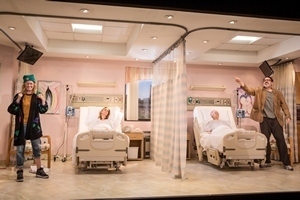
A Funny Thing Happened on the Way to the Gynecologic Oncology Unit at Memorial Sloan Kettering Cancer Center of New York City at the Lucille Lortel Theatre
(L-R: Beth Behrs, Lisa Emery, Jacqueline Sydney, and Erik Lochtefeld in A Funny Thing.)


There was no play on Broadway this season that celebrated the profundity and the healing power of human connection with a defter or more uplifting hand than Halley Feiffer’s A Funny Thing Happened on the Way to the Gynecologic Oncology Unit at Memorial Sloan Kettering Cancer Center of New York City (through July 3rd at the Lucille Lortel), which, despite what its name and subject matter might have you believe, it one of the least gimmicky productions I’ve ever seen.  It’s not about cancer at all, really -- it would be more accurate to say that it is a pure reflection of the unique and developing viewpoint of Ms. Feiffer, a playwright we’re all lucky to have.  That viewpoint, by the way, would be that when you place the human condition under the harshest of fluorescent lights, lights with which the hospital room set (all too familiar to anyone with an aging or sick relative) is rife, it tends to be disconcerting and not a little unpleasant.  But fundamentally, Ms. Feiffer seems to tell us with this clearly autobiographical and wrenchingly honest play, the saving graces of this sideways condition called life are art, love, and each other.  And even when we’re unwilling to take advantage of those things, they sometimes slip by nonetheless.
It sneaks up on you, this honest, brilliant, beautiful play.  The scenario -- fellow caretaking adult children Karla (Beth Behrs) and Don (Erik Lochtefeld) meet less-than-cute while visiting their sick mothers (Jacqueline Sydney and Lisa Emery) -- seems forced and unnatural.  Karla, especially, who wears disgustingly cool Supreme hats loose at the top and ironically loud bomber jackets, feels like a stereotype brought to life.  But we come to see quickly that Karla, domineered for years by her cutting matriarch, Marcie (who, when she wakes up and enters the action, sends a valuable jolt into the play thanks to Ms. Emery’s extraordinary vitality as an actress), and still grieving for her long-dead sister, has reached a point where everything in her life has become a defensive pose, and generates almost immediate and genuine friction when she’s brought into contact with the vulnerable Don, for whom nothing is.
There is no more accurate way to describe the performances in this play other than to say that they are gifts -- the kind of shockingly good stuff one sometimes finds off-Broadway and is thrilled to see having been snuck into the world.  Ms. Behrs, especially, takes you totally by surprise.  She is completely sympathetic and real, and she has the benefit of inhabiting a character clearly based on Ms. Feiffer herself (her mother, Jenny Allen, had cancer in the late aughts).  It is a character written with Ms. Feiffer’s characteristic unforgiving but nonetheless beautiful honesty, and one with whom we yearn to spend more time.  It’s a masterful performance by Ms. Behrs (trapped for what seems likely to be forever in the unforgiving shoals of the awful network sitcom 2 Broke Girls), not the least because her character is a stand-up comedian, one of the hardest professions to play believably.  But I never doubted for a second that Karla was a performer, and watching her carefully manufactured exterior drop as her character swerves further into vulnerability is a magnificent thing. (Incidentally, she also plays the large part in of of the most genuine -- and hilarious -- oral sex scenes I've ever seen on stage or screen.)

Mr. Lochtefeld’s Don, a wealthy former tech mogul whose family disasters (a drug-addicted son, a philandering wife, a borderline-comatose mother) have left him emotionally ruined, must, of course, form the other side of the inevitable but no less satisfying sparks-fly moment to which Don and Karla’s relationship eventually builds.  They are like salves to each other, and to the wounded nerves of the audience both from the more jangling parts of the play and of their own lives. His honesty matched with Ms. Behrs’ and Ms. Feiffer’s makes for a play that can only be called veritably optimistic in the best sense of the word.  In fact, one can only conclude from the warmth and joy this seemingly dark comedy seems to exude like lifeblood that Ms. Feiffer may be the last true optimist left in the upper echelons of modern playwrights.  Funny thing, that.

Wednesday, June 15, 2016

Wiving it Wealthily, if Not Quite Healthily

The Taming of the Shrew at the Delacorte Theater
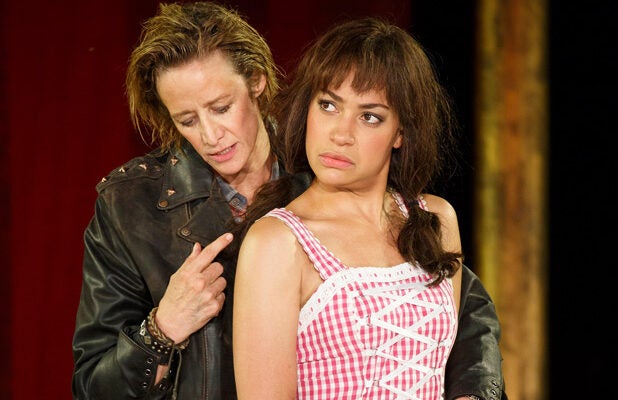
(L-R: Janet McTeer as Petruchio and Cush Jumbo as Katherine in The Taming of the Shrew.)


The three Shakespeare works referred to collectively as his “problem plays” -- Measure for Measure, All’s Well That Ends Well, and Troilus and Cressida -- are so called because of their dark, ambiguous dramatic choices, choices that seem off for the man who wrote Much Ado About Nothing and A Midsummer’s Night’s Dream.  But I would argue it is more accurately applied to those plays which are so mired in the social politics of their own times that they are impossible to produce today.  And I would further posit that at the top of that list belongs that often (and rightly) maligned 1592 work The Taming of the Shrew.
It’s that play, the basis for innumerable adaptations including Cole Porter’s 1948 Kiss Me, Kate, that starts the Shakespeare in the Park season at the Delacorte.  And it’s that play that the director Phyllida Lloyd (Mamma Mia!, the Donmar Warehouse Julius Caesar and Henry IV) attempts desperately to rehabilitate with an all-female cast, girl-power musical accompaniment, and jarring modern inserts.  It’s an admirable effort, but a vain one.  The Taming of the Shrew is a misogynistic play from start to finish -- its language is beautiful, but the crux of its drama has no redeeming qualities, dealing as it does with the gradual breaking of a woman’s (Katherine’s) spirit to be subordinated to her chauvinist husband (Petruchio).  Many a scholar has tried to find the reading of Katherine’s climactic fifth-act speech encouraging her fellow women to “place your hand beneath your husband’s boot,” with most clinging to irony as a last resort.  It doesn’t work.  This play cannot be saved. Shakespeare was a man of the sixteenth century -- that is to say, he was a sexist, and an anti-Semite to boot, though at least that other problem play, The Merchant of Venice, can be reinterpreted in view of changing times since Shylock is, at least from some viewpoints, a sympathetic character, while Katherine is left no recourse but to be domineered and trodden upon, into eternity.  
Ms. Lloyd’s attempt to salvage the ending starts with a slightly funny but mostly dissonant beauty-pageant joke at the expense of a presidential candidate who will remain nameless, which is left dangling for most of the show and fails to pay off until that final scene.  Cush Jumbo, as Katherine, has throughout the production given one of the most purely energetic performances ever on the Delacorte stage (and helps to convey the humor of the play admirably as it falls flat from her cast-members).  Now, as she beckons her fellow women, calling them “worms,” “weak and smooth,” telling them to “kneel for peace,” her voice breaks.  She barely seems able to hold herself together.  It’s traumatic to watch, and the audience is deadly silent.  Then that joke pays off, and there goes the dramaturgy.  It’s not that Ms. Lloyd’s ending isn’t plausible, it’s that it’s not entirely creative.  The philosophy seems to be that men collectively work to smooth the edges of women and force them to fit predetermined roles, which, while true, is not exactly a revelation.  Those who sacrifice the text for topicality and topicality for text, in turn, are doomed to get the better of neither.
The same could be said of most -- most but not all -- of Ms. Lloyd’s choices.  Judy Gold, as Gremio, breaks the fourth wall entirely too much for my taste, and the set and costumes (by Mark Thompson, an Australian) betray an everything-but-the-kitchen sink attempt at Americana.  It’s impossible to tell whether we’re in a circus, a trailer park, a Mafia wedding, a college town, or all of the above.  At one point, in a visually arresting (probably unintentionally) tableau, there are simultaneously actors on the stage in three-piece suits, leather jackets, ten-gallon hats, and fringed vinyl Davy Crockett coats.  Feeling so out of place does wonders for the wild and wonderful dance numbers that begin and end the show -- the music of all kinds that fills the production is, indeed, one of the best choices Ms. Lloyd has made, Shrew being such an intrinsically musical play -- but it fails to ground the action sufficiently.  The whole thing is far too broad, and it proves that Ms. Lloyd doesn’t trust the text.  And who can blame her?

The saving grace of the show comes from where you’d expect.  Janet McTeer plays Petruchio, and she owns the stage from the minute she steps onto it.  Her shrew-tamer is a crass, sadistic biker-boy, betraying only moments of sympathy towards Ms. Jumbo’s Katherine before she starts in on her again.  She is consistently and genuinely funny where the play isn’t, intelligent about motivation where the staging isn’t, and specific where most of the cast isn’t (a couple of holdouts excluded -- Gayle Rankin as Bianca is just the right mode of brat).  Her presence is absolutely remarkable, and she and Ms. Jumbo make their scenes together pitch-perfect at every turn.  When they’re alone on the stage, their chemistry immediate, their movement is intelligent, and their diction is flawless. Everything they do is right, and after they meet, their sense of infectious fun begins to bleed into the rest of the production, and even though it doesn’t entirely make sense, even though some of the unmasked sexism is cringe-worthy, you kind of can’t help enjoying yourself.  He that knows better how to tame a play -- or an audience -- now let him speak.

Tuesday, June 14, 2016

The Second Coming, with Light Musical Accompaniment

An Act of God at the Booth Theatre
Sean Hayes as the Creator in An Act of God.

There aren’t many ways to do a one-man show about God that won’t offend anyone, but David Javerbaum’s strikingly articulate comedy An Act of God comes pretty close.  That’s not to say it’s not daring, but rather to say that it doesn’t have much of an agenda beyond a ninety-minute barrage of genuinely funny jokes.  What philosophical throughlines there are amount to that divine being Himself coming to realize, gradually, that there is something seriously wrong with him, and making a last-minute stop-in on Broadway to clarify some of his new rules before he takes action on that problem.
Oh, and he’s played by Sean Hayes, which is always pleasant.  An Act of God was on Broadway last summer, too, then at Studio 54 with Jim Parsons in the title role; if Mr. Parsons is a more dynamic actor (and probably funnier, too, when not hamstrung by inferior material), then Mr. Hayes is more comfortably mature and seems to be having more of a great time onstage.  He’s got a sprawling white couch on a James Turrell-esque set by Scott Pask, two foils in the form of archangels Gabriel (James Gleason, delightfully taciturn) and Michael (David Josefsberg), and plenty of time to explain some of the things humanity has failed to understand about his divine wisdom.  “I don’t want a personal relationship with anybody,” he protests, explaining one of his his ten “new commandments” that form the structural basis of the evening.  “I want to put as much space between me and you as possible.  That’s what religion is for.”
All of this is funny to a surprisingly consistent extent; Mr. Javerbaum has found a rhythm with this show that he took years to develop with a corresponding book and comedic Twitter account -- it shows.  Mr. Javerbaum, an Emmy-winning writer for The Daily Show with Jon Stewart, also penned the book and lyrics to Cry-Baby, and his language and style are unique in their genuine attempts to plumb theological issues combined with a genuine desire to get to the punchline that never feels strained.  It’s purely excellent satire -- it’s not really trying for any new ideas, but it doesn’t really matter all that much because it’s just nice to be along for the ride.  It also helps that Mr. Hayes gets to take a couple of shots at himself -- God explains that he’s co-opted the Will and Grace star’s body for the evening (“He doesn’t even know he’s here”) because despite his being relatively unextraordinary at most things, “you kind of can’t help rooting for him.”  

The same could be said for this show, which is brief, to the point, and poignant (and directed by Joe Mantello -- always a plus).  Mr. Javerbaum is not a religious man, but he is clearly a deeply felt one -- the closing number to Stephen Colbert’s Christmas special, which he wrote with Adam Schlesinger, “There Are Much Worse Things to Believe In,” was a humanist paean to faith enough to jerk a tear and a laugh from even the most hardened cynic.  I was thrilled to see another Schlesinger-Javerbaum number close this show, in which God, preparing to abandon humanity, regales us with the comforting words “I have faith in you.”  It was funny, lyrically astute, and moving in the way it seems only a Javerbaum piece can be.  If nothing else, this production is another chance to experience a developing satirical voice in the theater from one of the unlikeliest of origins, and thank God for that.

Wednesday, June 8, 2016

2016 Tony Picks

The 70th Tony Awards will air Sunday the 12th at 8 on CBS, hosted by James Corden.


            Well, here we are, a few days before what is certain to be the most predictable Tony Awards telecast in recent memory.  It is not only possible but likely that Lin Manuel-Miranda’s juggernaut, Hamilton, will outdo the likes of The Producers (2001) and The Book of Mormon (2011) in its all-consuming, hype-fueled sweep of the ceremony, nominated as it is in every category for which it is eligible (for a total of 16 nominations — the most ever).  As any summary of Hamilton’s effect on the theater runs the risk of becoming hagiographic, I would begin my listing only by remarking that, when confronted live and in person, as we rarely are, with one of the greatest musicals ever written for the first time, it’s easy to resort to the same excitability and irrational hero-worship normally reserved for pop stars.  Hamilton will make history again on Sunday, without a doubt.  But don’t let’s forget that it is a piece of art.  Don’t let’s forget that it’s theater.  In other words – please don’t freak out.
            And now, he wrote, sighing, let’s see who’s going to lose to Hamilton this time.  Quotes from my reviews appear throughout.

Best Play: King Charles III
Ah, what a relief!  You-know-who isn’t up for this one.  The die has been preemptively cast by the bookies of Broadway on this one – Stephen Karam’s The Humans, a bleak, realistic family drama, has already won the Drama Desk Award, the Outer Critics’ Circle Award, and the New York Drama Critics’ Circle Award for Best Play.  But Mike Bartlett’s King Charles III, which closed in January, is the superior achievement by every benchmark.  It is not only a brilliant, resonant play written in iambic pentameter (which is achievement enough), it was also a joy to watch, which can hardly be said for Mr. Karam’s play.

Best Musical: Hamilton
Hamilton.  It’s Hamilton.  Okay?  In all honesty, this three-hour sung-through hip-hop musical about the life and death of the nation’s first Treasury Secretary would be a competitive player in almost any season.  (It’s fun to imagine Richard Rodgers gritting his teeth and taking a selfie with Mr. Miranda the way some of the other nominees in this category have during the past few months.)  This year, it’ll win without the slightest shadow of a doubt.  Despite my fatigue with the op-ed columns that rave about its impact, the fact is, they’re all right on the money (much like its subject — Ugh, forgive me).  Hamilton is an extraordinary achievement, certainly the greatest musical written since Les Miserables.  Just give him the damned trophy already and maybe we can talk about something else.

Best Revival of a Play: A View From the Bridge
Director Ivo van Hove is playing against himself here, as he so often is (he had four productions in New York this season).  But I’d pick his A View From the Bridge over The Crucible, if only for its stark, unforgiving physical beauty – courtesy of set designer and Mr. van Hove’s partner, Jan Versweyveld.  It was also better-acted than almost anything on the stage this season, and thematically pitch-perfect.  From my review: “A View from the Bridge is about a cycle of destruction, the remnants even of the things we hated crumbling to reveal that there was something worse lying beneath all along…  Van Hove begins the play with the actors being showered with water, cleansing themselves of the inequities of their lives.  At the end, from on high, they are doused with blood.”

Best Revival of a Musical: She Loves Me
From my review: “This is an absolutely delightful musical revived in an absolutely delightful production with a radiant ensemble (Michael McGrath, Nicholas Barasch, Jane Krakowski, and Gavin Creel are standouts), an irresistible sense of fun, and two perfect leads.  Laura Benanti, whose voice alone should be billed above the rest of the cast, had a cold on the performance I saw her, not that you would know it for the bravura performance she turned in.  The only thing that could match her singing voice is her funny, sympathetic, flawless stage presence.  A lesser actor would've quailed in her presence.  Instead, shockingly, the normally unremarkable Zachary Levi (late of NBC’s “Chuck”) more than matches her with the felicity of any rom-com leading man and energy that puts those leading men to shame.  (When Mr. Levi, six-three, pulled off a perfect cartwheel during the title number, I was barely surprised.)  I kept thinking he was doing an impression of some old matinee idol from the forties before I realized it was only that he was turning in a performance that would not seem out of place there -- the first I've seen in a while.  If I loved this trademark Scott Ellis production absolutely to death, if I would readily see it again several hundred more times, it’s for the same reason anyone still watches old romantic comedies -- the boy and the girl helped me fall in love with an old, dear friend all over again.”

Best Book of a Musical: School of Rock
Julian Fellowes’ book for the Andrew Lloyd Weber extravaganza School of Rock will not win this category.  But on principle, I refuse to give this award even theoretically to a show (namely, Hamilton) that’s sung-through.  If we’re worshipping Lin-Manuel Miranda to the point that we’re giving him awards for things he hasn’t even done, I’m not sure how comfortable I am with the Tonys after all.  Plus, Mr. Fellowes, the creator of Downton Abbey, did a surprisingly excellent job on the libretto for this adaptation of the 2003 Jack Black film: “Without losing any of the best parts of Mike White’s original film script (‘I have been touched by your kids… and I’m pretty sure I’ve touched them’ still gets laughs), he has rounded out characters, elucidated motivation, and adapted the hazy world of Richard Linklater to the more brightly lit one of Broadway, all without missing a beat.  His contribution refuses to be overlooked.”

Best Original Score: Hamilton
You know where this is going.

Best Performance by an Actor in a Leading Role in a Play: Mark Strong, A View From the Bridge
“The most brilliant piece of scenic design in Ivo van Hove’s production of A View From the Bridge, at the Lyceum, isn’t the colossal cubic structure that rises from the stage to reveal a stark, sterile boxing ring of a set, on which the production unfolds.  No, a much more interesting visual experience is Mark Strong, playing the doomed Eddie Carbone as colossal in more than one way.  Backlit by the same unforgiving white glare that floods the entire production… Mr. Strong in profile, his nose like a tomahawk above his near-perpetual sneer, is terrifying, an avenging angel.  When he turns toward the audience, you cower… Mr. Strong, reckless, ruthless, and daring, embodies Eddie as carnal, even monstrous, but never less than a man.  Miller would be shocked but impressed.”

Best Performance by an Actress in a Leading Role in a Play: Sophia Okonedo, Arthur Miller’s The Crucible
Ms. Okonedo, the only palatable part of Kenny Leon’s 2014 A Raisin in the Sun revival, steals a show here that’s very difficult to steal.  Ben Whishaw and Sophia Okonedo, as the Proctors, the skeptical couple who find themselves at the mercy of mob hysteria, steal the production, turning in sensitive, understated performances full of love, tenderness, and authenticity.  Where Mark Strong, in A View From the Bridge, bellowed and growled in fear of loss of his world, Okonedo and Whishaw stand proudly and finally bow humbly.”  (Incidentally, Mr. Whishaw’s being snubbed in the Lead Actor category is nearly unforgivable.)

Best Performance by an Actor in a Leading Role in a Musical: Leslie Odom, Jr., Hamilton
Leslie Odom Jr., the outright best performer in a musical with a lot of legitimate claims to that title, referred to Aaron Burr as the greatest part written for a male actor of color in the musical theater canon.  It’s a broad statement, but upon consideration, he’s absolutely right.  What he left out is that Burr may well be the best-written villain in the musical theater canon – with enviable smoothness, an all-too plausible motivation, and a sounds-of-insanity breaking point number (“The Room Where it Happens”) to rival Sondheim’s best.  Aaron Burr is a flawless musical theater character, and Mr. Odom does him justice.

Best Performance by an Actress in a Leading Role in a Musical: Phillipa Soo, Hamilton
This is the one category most experts are giving to someone else besides Hamilton – namely Cynthia Erivo for The Color Purple.  But of all Hamilton’s disparate elements, I feel Ms. Soo, as Hamilton’s stoic wife, Eliza, gets the least credit for her brilliance.  In a show full of feats of energy, Ms. Soo stays quiet and low-key, which makes her final moment in the spotlight that much more significant.  She gives the role of the woman in the nation’s founding its sudden – and surprising – focus in a show about male accomplishments.  Plus, her voice is ridiculous, and however many times the show might tempt her to be, she never becomes boring.  (Quick note, though: Where’s Audra?)

Best Performance by an Actor in a Featured Role in a Play: David Furr, Noises Off
For me, this is just a little opportunity to go against the grain.  Most experts will give this one to Reed Birney, of The Humans – and he’d deserve it, no question.  He’s a subtle and understated actor who’s been earning his stripes in low-profile jobs for years.  His performance, I wrote in March, “elevates [Stephen] Karam's excellent, funny, spilling-over dialogue to new heights.”  But David Furr, who, coincidentally, I saw the same weekend in the 1982 farce Noises Off, cemented his place in that short-lived production as a paragon of slapstick, playing most of the play straight before shocking the audience by “achiev[ing] things with his body I had not previously thought possible for those not composed of rubber.”  His pure daredevilry alone, to set aside his near-perfect delivery, deserves some kind of award.

Best Performance by an Actress in a Featured Role in a Play: Jane Houdyshell, The Humans
The snubs this year are harder to see, and one of them is in this category – though Noises Off scored two nominations, for an unremarkable performance by Andrea Martin and an amusing one by Megan Hilty, Tracee Chimo, Broadway’s most valuable character actress, was left by the wayside, perhaps because she “disappear[s], chameleon-like, into her demure, nervous stage manager.”  With two other nominations for Eclipsed, the vote-splitting will probably result in an utterly deserved win for the fantastic Jane Houdyshell, long relegated to completely uninteresting aging-mother roles, who finally got a fascinating one here.  She has a riveting intensity and majesty as an actress that “renders the issues of her squabbling brood,” the Blake clan, “seem like minor complaints by comparison.”

Best Performance by an Actor in a Featured Role in a Musical: Daveed Diggs, Hamilton
In February of 2015, when I first saw Hamilton at the Public, I praised Mr. Diggs’ “incredible dedication to his [dual] roles and audience-pleasing comic dexterity.”  Since then, upon reception of the masterfully produced cast recording, I’ve come to appreciate something else – his unadulterated talent as a rapper.  That a Broadway musical could serve as a showcase for someone of Mr. Diggs’ particular skill set – he’s the lead MC for LA-based hip-hop group clipping.) – is one of the more impressive things about Mr. Miranda’s achievement.  With some difficulty, Mr. Diggs should muscle his way past equally impressive performances from fellow Hamilton cast-members and nominees Jonathan Groff and Christopher Jackson.

Best Performance by an Actress in a Featured Role in a Musical: Renee Elise Goldsberry, Hamilton
“Ms. Goldsberry,” I wrote in my Hamilton review, “offers a preview of what is sure to be a long and rewarding career — she sings the hell out of anything she’s given.”  This was perhaps an unfair characterization since she’s had a ten-year career in everything from the last cast of Rent on Broadway to originating the role of Nettie in The Color Purple (Danielle Brooks in the revival now contests this award).  But this is the first role she’s originated of any consequence, and it will be difficult for any future actress to take the reins.  Playing Hamilton’s sister-in-law, Angelica, she makes Eliza seem something of a milquetoast by comparison, and she’s a masterful rapper on top of her singing ability.  More and more she seems the female counterpart to Mr. Miranda, certainly exceeding his performing ability and proving night after night she can play with the big boys.  A pity about Jane Krakowski in She Loves Me – God, she’s good, but business is business.

Best Scenic Design of a Play: Jan Versweyveld, A View from the Bridge
From my review: “Rarely on Broadway has scenic design and staging intersected so directly with the heart and soul of a production.”  Mr. Versweyveld is a genius, pure and simple, a man completely in control of his craft and his art.  His collaboration with Ivo van Hove in art and life is destined to go down as one of the theater’s great partnerships.  He brings a much-needed foreign perspective to scenic design in a category usually dominated by Americans and Brits.  And his “colossal cubic structure that rises from the stage to reveal a stark, sterile boxing ring of a set, on which [A View from the Bridge] unfolds,” was certainly his best work of the four productions he designed this season.  He’ll win lighting design, too.

Best Scenic Design of a Musical: Es Devlin and Finn Ross, American Psycho
Ding ding ding, ladies and gentlemen, we have our first Hamilton upset!  Three of the four greatest scenic designers in the world are up for Tonys this year – Mr. Versweyveld, Ms. Devlin and David Rockwell – leaving out only Bob Crowley, but he was nominated four times last year, so I feel he deserves a break.  In this category Ms. Devlin’s and Mr. Ross’s “seemingly infinite hall of mirrors and pristine white walls,” an innovation in a musical that lacked any others, bests Mr. Rockwell’s candy box of a She Loves Me set by a hair.  David Korins, who’s nominated in this category for Hamilton, seems to me to get entirely too much credit for his simple and relatively unexciting set.  Jeremy McCarter, in his adulatory biography of Hamilton’s creation, Hamilton: The Revolution, says of Mr. Korins’ set that it “evoke[s] both then and now… [is] both general and specific… substantive yet nimble.”  Seems to me it just gets the job done.  Ms. Devlin (a tour designer for the likes of U2) and Mr. Ross (who designed the Curious Incident of the Dog in the Night-Time) blow minds, and their work should give an unremarkable show a memorable win over a masterpiece.

Best Direction of a Play: Ivo van Hove, A View from the Bridge
From my review: “[Mr. van Hove’s] signature is treating American classics with the same probing interest most contemporary directors have for Shakespeare -- in his Angels in America, the wings and delicate airs of the Angel are traded for vainglorious abusiveness; in his Rent, Mimi dies.  His idea of a good time is taking the self-regard this country has for its theatrical heroes and stripping away the accoutrements.”  This A View from the Bridge is the prototypical van Hove production, one that deserves the same study that nitpicks the backstage details of the original production of A Streetcar Named Desire.  His methods and talent are so clearly on display here that he nearly makes himself the star of the production.  It’s an auteur turn, something one only expects to see in film but is occasionally surprised to see on Broadway.

Best Direction of a Musical: Thomas Kail, Hamilton
This is the strongest all-around category of the ceremony.  Michael Arden, John Doyle, Scott Ellis, and George C. Wolfe are at varying stages in their careers, but all are phenomenal.  Mr. Wolfe, in fact, in his wrangling of an ensemble so talented it threatens to tear itself apart, pulls off a very similar feat to Mr. Kail.  But I’ve got to give it to the latter, if only because Hamilton is a force of nature, and making sure something like that lands night after night is a hell of a lot harder than it sounds.  Among the toughest imaginable competition, Hamilton triumphs again.  Go figure.

Best Choreography: Andy Blankenbuehler, Hamilton
There’s nothing like letting yourself be taken over by a performance.  And the non-stop, effortless choreography of Andy Blankenbuehler, who also did In the Heights, Mr. Miranda’s earlier musical, washes over an audience like a forceful, breathtaking wave.  No half measures here – everything is full-on or not done at all.  The freedom of a stylistically varied musical like this one gives Mr. Blankenbuehler the latitude for a Savion Glover-like turn in the spotlight – ironic, since he’s up against Mr. Glover here, nominated for Shuffle Along.  He should beat him easily, though, as well as equally worthy Jerome Robbins impersonator Hosef Schechter for Fiddler, on the strength of the Hamilton sweep.

Best Orchestrations: Alex Lacamoire, Hamilton
Mr. Miranda’s writing process is fairly simplistic – he cobbles together demos on his computer, using pre-recorded beats and mangled piano tracks (he himself admits he’s a pretty terrible pianist).  So at least half of the credit for Hamilton’s magnificent score goes to his partner, Alex Lacamoire (also of In the Heights), who has assembled complex orchestrations incorporating musical styles both old and new with shocking ease.  Above all, he’ll be forever remembered as the man who put a banjo in “The Room Where it Happens” – I’d argue the most brilliant orchestral choice since Anton Karas scored The Third Man.

Technical Awards (featuring two more Hamilton upsets!)

Best Costume Design of a Play: Michael Krass, Noises Off

Best Costume Design of a Musical: TIE between Jeff Mahshie for She Loves Me and Ann Roth for Shuffle Along (Hamilton upset!)

Best Lighting Design of a Play: Jan Versweyveld, A View from the Bridge

Best Lighting Design of a Musical: Jules Fisher and Peggy Eisenhauer, Shuffle Along (Hamilton upset again!)

Total Count (Multiple Wins)
Hamilton: 9
A View from the Bridge: 4
She Loves Me: 2
Shuffle Along: 2
Noises Off: 2