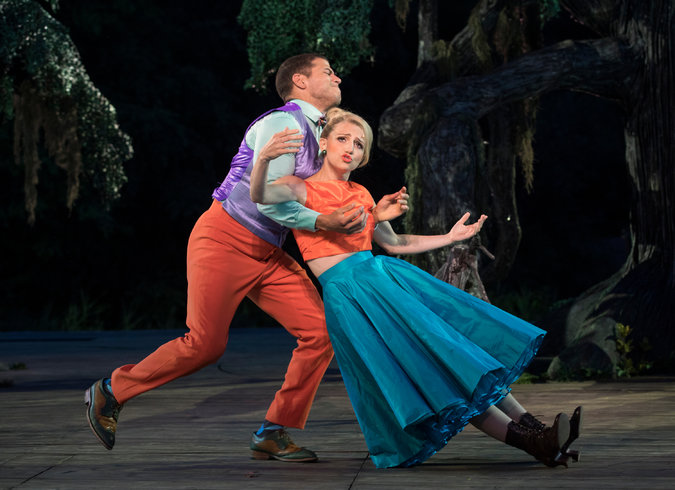
The 72nd Tony Awards,
hosted by Josh Groban and Sara Barielles, air Sunday the 10th at 8
on CBS.
Welcome to the age of the revival.
We get one really good new musical a
season, it seems, in this trying day and age, and this year it’s David Yazbek
and Itamar Moses’s The Band’s Visit. All the rest is brand names and intellectual
property, noise and block letters, a tale told by an idiot, full of sound and
fury, signifying nothing. In other
words, Frozen, Mean Girls, and SpongeBob
SquarePants (shudder), the other three nominees, plus Escape to Margaritaville, Rocktopia, and The Donna Summer Musical.
God forgive us. Well, this year
as every year, our chosen few (Yazbek, Moses, and director David Cromer) will
make their fated, unobstructed walk to the podium, just as Pasek and Paul,
Lin-Manuel Miranda, Tesori and Kron, and Lutvak and Freedman did before. The slate of musical revivals – one perfect
and one painfully near-perfect – will dominate the night. And that is the state of the art.
Reliance on revivals is nothing new –
three out of the last seven winners for Best Revival have been better than
their Best Musical counterparts – except that this year it goes for straight
plays as well as musicals. In all
likelihood Harry Potter and the Cursed
Child, nobody’s Shakespeare, will
walk away with Best Play, but, if Tony knows what she’s doing, the perfect Angels in America revival will sweep the
rest of the play categories. Tony
Kushner’s a great genius of our age. But
this season would have you believe he’s the only one.
It’s altogether possible (though unlikely)
that the Tonys could prove themselves irrelevant once and for all by doling out
the top awards to the yellow sponge mentioned above, plus some of his phony
Hollywood friends. But the end of a
season like this one is the time for reflection not just on awards but on the
art form they’re meant to celebrate. If
this is how Broadway looks from now on – one Hamilton or Sunday in the
Park with George or Clybourne Park or
Angels in America every thirty years,
and the rest silence – where else can this glorious medium, this majestic old
Miss Havisham, this live theater, flourish?
As Leslie Bricusse and Anthony Newley wrote (and, incidentally, went
Tonyless for) in 1964: “Who can I turn to if you turn away?”
Best Musical: The Band’s Visit
The thing
about The Band’s Visit is that it isn’t
really great. It’s purposefully small
and quiet and less than lavish, which I appreciate, but it can occasionally
feel so slight it threatens to fall in on itself. But it advances the art form – I have no
doubt its dismissal of choreography as necessary to storytelling will have its
influences – and it’s the best new musical, by far, of this season, on the page
and on the stage. Not that it’s a
particularly high bar.
Best Play: The Children
This being
as weak a year for new plays as for new musicals, I haven’t seen The Children, nor the play most likely
to win this category, the aforementioned Harry
Potter. (Nor have you, most likely, unless
you’ve got five hundred dollars handy and the wherewithal to wait a month or
six to visit what’s essentially a Broadway play-shaped tourist
attraction.) But I have read Harry Potter and the Cursed Child, as written
by Jack Thorne, and it’s a mess – shapeless, meandering, and lacking even
sparks of the imagination J.K. Rowling lavished on every syllable of the
original books. It’s a hopeless retread,
impressive stagecraft or no, and so out of principle The Children gets my vote, if only because, by all accounts, it’s
actually a good play. That’s certainly
more than can be said for Harry Potter,
or a third, misbegotten competitor in this category, the confused Farinelli and the King.
Best Revival of a Musical: Carousel
It’s been
said over and over again – by Chris Jones of the Tribune, who wrote, “God is in Carousel;”
by Marilyn Stasio in Variety, who
called it “immaculate” and “sheer bliss” – but it bears repeating: Jack O’Brien’s
revival of Carousel is
diamond-perfect, all the way through. As
powerful and wrenching as anything ever seen on Broadway, O’Brien’s production
clears in one fell swoop the naysayers who cast aside the Golden Age as a
model, while also (unfortunately) reminding us of the state of musical theater
by proving to be the most emotionally resonant show this season. It’s a piece we should revive once every ten
years, at minimum, and this production reminds us why.
Best Revival of a Play: Angels in America
Marianne
Elliott’s revival, originally at the National Theatre in London, has got to be
the fleetest eight hours anyone could spend in a theater. One of the biggest surprises about this revival
of a very heavy show is how very light it is on its feet. But what isn’t surprising, given the level of
talent involved, is how goddamned great it is, every second of it – and I do
mean every second – despite the fact
that the enormity of this American masterpiece only really becomes clear at the
tail end of that marathon of a runtime. Normally,
stagecraft this good and acting this terrific, when paired, tend to fall into a
duel for the audience’s attention. Not
so here. Faced with stiff competition, wonderful
revivals of Kenneth Lonergan’s Lobby Hero
(which would have won any other year) and Tom Stoppard’s Travesties, Angels will win, and win it all.
And why shouldn’t it? Not only is
the play, and the production, superb theater, it also somehow outdoes the very concept of theater itself. It’s
a prophecy, maddening and thrilling and galling all in one.
Best Book of a Musical: Itamar
Moses, The Band’s Visit
Itamar Moses’s
work on the book for this story of an Egyptian police band stranded in a small
Israeli town overnight is minimalistic, and purposefully so, which is
stylistically fascinating given that librettos generally tend to wilt when
confronted with scores, but not of their own accord. In his structured retreat from consciously
eye-catching moments, Moses creates room for his actors’ and his composer’s
work to shine. It’s what a skilled musical
theater writer does, and if the Theater Wing ends up giving this award to Tina
Fey, who essentially copy-pasted her 2004 film script for Mean Girls, we’ll know it’s just because they wanted to hang out
with her at the after-party. She’s a
genius, but come on.
Best Original Score: David Yazbek, The Band’s Visit
There are
two great original songs in David Yazbek’s score to The Band’s Visit, which is more than in the rest of the nominees
combined. (Frozen brings along some of its hits from the movie version, but
let’s be adults for a change.) Yazbek
has never been the most purely talented of the cadre of the current elite in
musical theater – Jason Robert Brown is more masterful, Miranda more appealing,
William Finn wittier – and even Dirty
Rotten Scoundrels (2005), his biggest hit thus far, leaves a bad taste in
one’s mouth. But with this score, he
brings the Middle Eastern sound into the Broadway mainstream, as impressive in
its own way as Miranda’s hip-hop – perhaps more, since Yazbek’s achievement had
not a hint of precedent. Plus those two
songs are pretty damn good.
Best Leading Actor in a Play:
Andrew Garfield, Angels in America
Andrew
Garfield is the leading ham of the season, and that’s a compliment. His screeching, swooping Prior Walter, half Gloria
Swanson and half Jeff Goldblum, is a journey through human life, the gestation
of a prophet, and his final, quiet, humble “The great work continues” is
colossally moving if only because we’ve seen him do the great work, and eight
hours of it. People have been saying it since
his 2010 turn in The Social Network,
but let me add to the echoes – keep your eye on this one.
Best Leading Actress in a Play:
Glenda Jackson, Three Tall Women
Now and
again a performance comes along that reminds one what it is to be a real actor, and everyone else seems to
pale by comparison. Such a performance
Glenda Jackson gives in Joe Mantello’s revival of Albee’s Three Tall Women, and she will and should win here, no
contest. It’s a terrifying performance,
cold, distant, bent by age, but suffused, too, with the somehow infectious
humor of someone who knows she knows better than you do. Jackson’s character, A, has been reduced to
rubble by a profoundly unfair life, but Jackson herself, back in the saddle
after three decades as a member of British Parliament, towers.
Best Leading Actor in a Musical:
Joshua Henry, Carousel
One of the
less-discussed positive ramifications of the Hamilton phenomenon is the increased prominence it’s given to the massively
talented black actors who’ve done a tour as Burr. Brandon Victor Dixon gave a performance in NBC’s
Jesus Christ Superstar Live that
lends credence to the theory he’s the most talented man alive, and Joshua
Henry, who replaced Dixon in Hamilton,
offers nothing less than a gift to the theatergoing public with his athletic,
wonderful Billy Bigelow. His “Soliloquy,”
a first-act closer to end all first-act closers, forces its way out of him with
such emotional heft it actually contorts his body.
Best Leading Actress in a Musical:
Jessie Mueller, Carousel
Jessie
Mueller should win this award but probably won’t, because Tony voters, blinded
by dazzle, probably aren’t trained to recognize and appreciate what she does so
perfectly as Julie Jordan in Carousel
– stillness. Since her Tony Award-winning
performance in Beautiful, from 2013,
she’s cultivated a kind of a quiet dignity as a performer that lends total
credence to Julie’s anchoring of the tragically uncontrolled characters with
whom she shares the stage. It’s tough to
play utter goodness believably, but Mueller knows what the hell she’s doing,
and she knocks it out of the park.
Best Featured Actor in a Play:
Nathan Lane, Angels in America
God, but
Nathan Lane’s good at everything. In the
‘90s, he tackled the great roles of musical comedy, and now, older (he’s
sixty-two), wiser, and, if anything, better, he’s taking on the whoppers of the
straight theater. After playing Estragon
in Waiting for Godot in 2009 and Hickey
in The Iceman Cometh in 2012 and 2015,
he’s taken on Roy Cohn, and he’s titanic, earth-shattering, flawless – what else
is there to say? If he wants to try
Stanley Kowalski next, that’s fine by me.
Best Featured Actress in a Play: Laurie
Metcalf, Three Tall Women
Laurie
Metcalf just won Best Actress in a Play (for A Doll’s House Part 2) last year, and should have won Best
Supporting Actress at the Oscars this year (for Lady Bird). (Instead, it
went to Allison Janney, who was good but not even the best performer in I, Tonya, let alone of the year.) Her work backing up Jackson in Three Tall Women is more than worthy of
another award, if only because, in her role as a caretaker (her first of two
roles in the play), she enlivens and expands the first act beyond Albee’s usual
played-out cynicism and into the realm of the actual.
Best Featured Actor in a Musical:
Norbert Leo Butz, My Fair Lady
In a
musical filled with performances almost
worthy of Tonys (Lauren Ambrose as Eliza and Harry Hadden-Paton as Higgins come
to mind), Butz should grab the brass ring for his third Tony and first as a
featured actor. He is a ball of chaos rampaging
through what, in the wrong hands, could easily become a stultified musical; his
motions are herky-jerky and his energy is delightfully devilish. His wild “Get Me to the Church on Time” is
the highlight of the production.
Best Featured Actress in a Musical:
Lindsay Mendez, Carousel
Carousel is by its nature elevated; the reason
it packs such a punch is that its characters and premise seem the distillation
of the emotions that inspired them. Mendez,
though, in her bubbly warmth, and with her fascinating and supple voice, is the
realest actor in the production. One
gets the urge to watch her work her way through the Golden Age canon and beyond. She’s a performer best known for her work
Off-Broadway (most notably as the female lead in Pasek and Paul’s Dogfight), but she’s got Broadway
promise, and I’m excited to see where she goes next.
Best Scenic Design of a Play: Ian
MacNeil and Edward Pierce, Angels in
America
The best
thing about MacNeil and Pierce’s work on Angels
is that their scenery actually evolves over the course of the play. Early in the first part of the two-parter, Millenium Approaches, the stage is
occupied mostly by three turntables, each dedicated to one of the three
storylines; eventually, as those storylines themselves become disordered, the
turntables begin to bleed into each other and eventually disappear by the end
of the part. In part two, Perestroika, their motifs change to
horizontal layering – a hospital room that moves back behind an apartment,
another apartment that rises from the floor downstage in front of that
one. Then, after Prior’s climactic
journey to heaven near the end of the play, the stage empties, leaving behind
only the Bethesda Fountain angel, outlined in neon, watching over the detritus
of the centuries. Watching the scenic
design in Angels is like watching
another feat of acting alongside the ones already present in the play; MacNeil
and Pierce’s work itself feels.
Best Scenic Design of a Musical:
Michael Yeargan, My Fair Lady
Every
Yeargan set for a Sher production at the Vivian Beaumont is a visual
experience. 2015’s The King and I was perhaps the ultimate example of the
collaboration – making unparalleled use of the Beaumont’s remarkably deep stage
with a massive boat in the opener and a palace for the King of Siam that had to
be more opulent than the real thing. But
My Fair Lady ain’t far behind – the image
of Higgins’ townhouse roaring forward through a black void toward the audience
is the most overwhelming image of the season, and the gorgeous azures of the
Ascot sequence seem certain to become the standard for future productions. Yeargan should take this in a walk.
Best Costume Design of a Play: Nicky
Gillibrand, Angels in America
If Nicky
Gillibrand had only dressed Andrew Garfield’s Prior Walter, she’d deserve the
award anyway. Prior, a former drag
performer, spends a good deal of Perestroika
dressed as Norma Desmond; his figure, swathed in black, recounting the
story of his encounter with the Angel, is instantly iconic. By the end of the play, Prior’s costume –
along with everyone else’s – seems to loosen to allow him room to breathe. His final lines are, if anything, driven home
by his beautiful plaid suit and overcoat, the kind of clothes he would wear on
what he describes as a crisp early winter morning – his favorite kind of day. Gillibrand’s last credit was the dreary Billy Elliot the Musical, for which she
was nominated for the Tony. Here, she
makes a triumphant comeback.
Best Costume Design of a Musical:
Catherine Zuber, My Fair Lady
There are
some beautiful clothes in this My Fair
Lady – as there essentially have to be.
It’s a show deeply concerned with clothes as part of its being deeply
concerned with appearances, and how they separate us. Zuber does good work on Eliza’s dresses –
shades of green and orange, mostly – and the opulent creams and pinks in the
Ascot sequence. But one can sense she’s
more interested in Hadden-Paton’s Higgins, and his sweeping dressing gown, and
the stunning checked suit he himself wears to Ascot, offer delicious proof of
his arrogance and undercut his professed democratic ambitions.
Best Direction of a Play: Marianne
Elliott, Angels in America
Marianne
Elliott, director of War Horse and The Curious Incident of the Dog in the
Night-Time, has long recognized that live theater is more than capable of
the cinematic. With Angels she delivers her greatest achievement, in collaboration with
her scenic designers, Ian MacNeil and Edward Pierce, and her lighting designer,
Paul Constable, all three of whom should win as well. Figures fade into darkness and reappear, behind
layers of an inchoate set that completely transforms over the course of the
play’s two parts. Many great directors –
Brecht among them – become so preoccupied with their technical genius that they
leave actors behind them. Elliott’s
never fallen into that trap. In Alex
Sharp’s performance in Curious Incident,
from 2014, she coaxed out one of the greatest stage performances in recent
years. In Angels, with Lane and Garfield, she brings us two more. Give her the Tony. Let her direct everything.
Best Direction of a Musical: David
Cromer, The Band’s Visit
Jack O’Brien
deserves this award for Carousel, and
why he wasn’t nominated for it will remain forever beyond me. Bartlett Sher, meanwhile, in his work on My Fair Lady, nearly pulls off a terrific
evening of rousing spectacle but undoes it with a stupid and dramaturgically
limp choice of ending that undoes much of what came before it. That leaves Cromer, whose work is strongest
in the small, beautiful moments for which Yazbek and Moses’s small musical
makes ample room. So many moments in The Band’s Visit are traced in circles: In
lieu of a dance routine, a character spins a plate around on a table and stares
at it; a budding love affair develops in every lap around a skating rink; a
turntable rotates at what seems like the same rate as gravity drives the
residents of Bet Hatikvah, Israel ever further into the ground. The Band’s
Visit was supposed to be directed by Hal Prince, and it’s hard to think of
a more polar opposite to Cromer’s style – Prince sells it with a personal style
that overrides almost everything else, but Cromer, like Moses, knows when to
step back.
Best Choreography: Justin Peck,
Carousel
If ever
there were a case of a choreographer gunning for a Tony, it’s surely the “Blow
High, Blow Low,” sequence in Carousel. Justin Peck, the Resident Choreographer of the
New York City Ballet, makes use of one of his principal dancers, Amar Ramasar
(as Jigger Craigin), plus a thrilling male ensemble, in the service of
choreography that, described in the abstract, would sound nearly
impossible. Sometimes a Tony is deserved
for evident effort, other times for transcending the human. Peck fits both categories.
Best Orchestrations: Jonathan
Tunick, Carousel
Tunick
shines in that aforementioned “Blow High, Blow Low,” sequence, too, with spot-on
string and brass runs to beat (and show off) the band, but he’s on his game
throughout, delivering pitch-perfect interpretations that serve to remind the
audience of the perfection of Richard Rodgers’ music. Tunick exists in the service of the music,
but he’s impossible to ignore – that’s how he won his EGOT, and won the
first-ever Tony Award for Best Orchestrations in 1997 (for Titanic), the only time he’s ever won it. He should pick up another Sunday in a dead
heat over the equally talented Jamshied Sharifi for The Band’s Visit.
Technical
Awards
Sound Design in a Play: Ian
Dickinson for Autograph, Angels in
America
Sound Design in a Musical: Kai
Harada, The Band’s Visit
Best Lighting Design of a Play:
Paul Constable, Angels in America
Best Lighting Design of a Musical:
Donald Holder, My Fair Lady
Multiple Awards
Angels in America, 8
Carousel, 6
The Band’s Visit, 5
My Fair Lady, 4
Three Tall Women, 2